
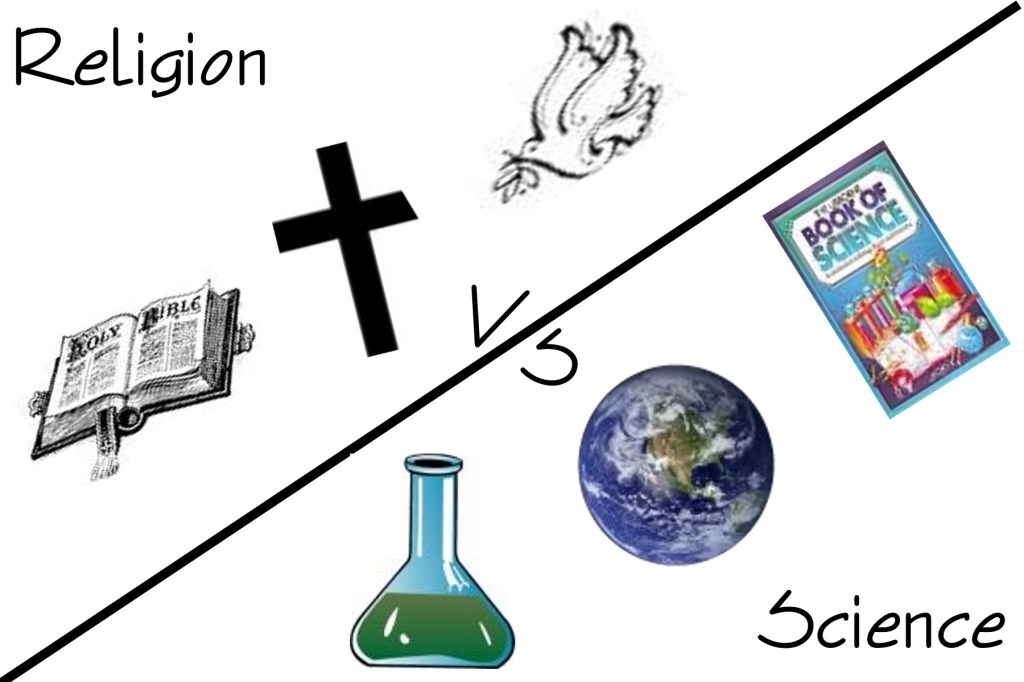
At the start of our junior year in high school, Cameron Corey and I made a bet as to which of us would get a higher grade in chemistry. We were highly competitive with one another, and both believed we would do well in chemistry, or any other class we competed in. Cameron found science easy, and did quite well in chemistry, getting an easy A. I, on the other hand, struggled mightily. On one notable experiment, while the rest of the class finished in two days, I continued to flub the experiment, until after two weeks, the teacher begged me to give up. Finally, he made a deal with me: if I promised never to take another class from him or anyone else in the science department, I would get a C. I accepted, and lost my bet.
Someone might look at this and say, “Why of course you did badly, after all, you were a Christian, and we all know they are anti-science. Cameron did well because he wasn’t one of ‘them.’” Actually, my poor showing in science had nothing to do with being a Christian. It had more to do with the fact that as I struggled to understand, I kept getting further behind. Unfortunately, as a number of teachers and professors would testify to this day, when I get behind, or do not understand, I can be a handful. Just ask my French or Greek teachers, who constantly shook their heads as I entered the classroom.
One reason that Christians are seen as anti-science is history. The most famous example often cited is that of Galileo, who proved that the earth revolves around the sun, rather than the other way around, as was believed by most all of society. The problem for the church of the day, was that Biblically they were constrained in any teachings by Jesus assertion that “you shall know the truth, and the truth shall set you free.” Thus the church was charged with ensuring that anything taught as fact must be truth. The church did not forbid Galileo to teach this revolutionary scientific fact, instead they offered to let him teach it as a theory while they put their best scientists to work trying to prove whether or not it was true. Galileo was arrested because he reneged on the deal. This was actually a point for the church in its scientific pursuit of truth. You can dig deeper here with Ohio State University.
The church did not automatically reject this new finding, but instead they set about using scientific experimentation, math, and reasoning to come to the same conclusion as Galileo had. And Galileo was in fact a person of faith.
Other persons of faith have always been deeply involved in genuine scientific inquiry throughout time. While I have neither the space nor inclination to attempt an exhaustive list, a few shall suffice. Let’s start with Robert Grosseteste, an English bishop from the 13th century who wrote textbooks on astronomy, optics, and geometry. He insisted that experiments should be employed to test and verify theories. He was a firm believer in what we call the scientific method. Blaise Pascal was not only involved in theology, but in physics and math as well. Isaac Newton, who “discovered” gravity, was a noted Christian apologist. Gregor Mendel, found in most high school biology textbooks as the “founder of modern genetics”, was a church leader in the 19th century.
And it’s not just in the past that we find Christians heavily involved in the sciences. Perhaps the most famous example of a modern day Christian in the STEM field is Francis Collins. Originally an avowed atheist, Collins headed the Human Genome Project. At some point, his forays into scientific exploration headed him toward a faith in a personal, Christian God. Today, he is the head of the National Institute for Health, a federal government agency.
And Collins is not alone. A quick look at Wikipedia (yes, I know, it’s often wrong, but still!) shows a large number of current scientists who are both Christians and scientists. To assume that you must be one or the other is a false dichotomy.
But surely, you will interject, what about all the crackpot ideas that all Christians entertain? First, not ALL Christians entertain the same ideas about scientific facts. We are not monolithic in our beliefs and in our understandings of the world around us. Neither are scientists. They often can be observed arguing against one another’s “pet” theories and beliefs.
Are Christians, or other people of faith anti-science? My answer to that is: It depends!! As in any other debate, it depends on the person. And it is not just Christians. For instance, we have seen a number of athletes and entertainers in recent years state that the earth is flat. They do not do so out of a profound belief in God, but out of some misguided understanding of our world and the universe it inhabits. I’m not sure I would call them anti-science as much as misinformed and possibly conspiratorial. The same goes for anti-vaxers, and a whole host of others whose scientific thoughts are not necessarily with the norm.
My father, an avowed atheist, insisted on two “FACTS.” First is that it was and always will be impossible for man to go into space, and therefore land on the moon. Therefore, second is that all the space exploration and moon landings were faked by the government. Every time we got on this topic, I would inwardly shake my head as dad would patiently explain his reasoning. And don’t scoff – dad had some well thought out reasons for believing as he did. Reason I never accepted, and always disagreed with.
So are Christians anti-science? Not really. But like everything else, it depends on the individual. I do not hold atheists responsible for my father’s beliefs, any more than they should hold all Christians responsible for the beliefs of a few. Until next time.
 Tracy AtHome Church